Why Are Control Components Essential in Modern Technology?
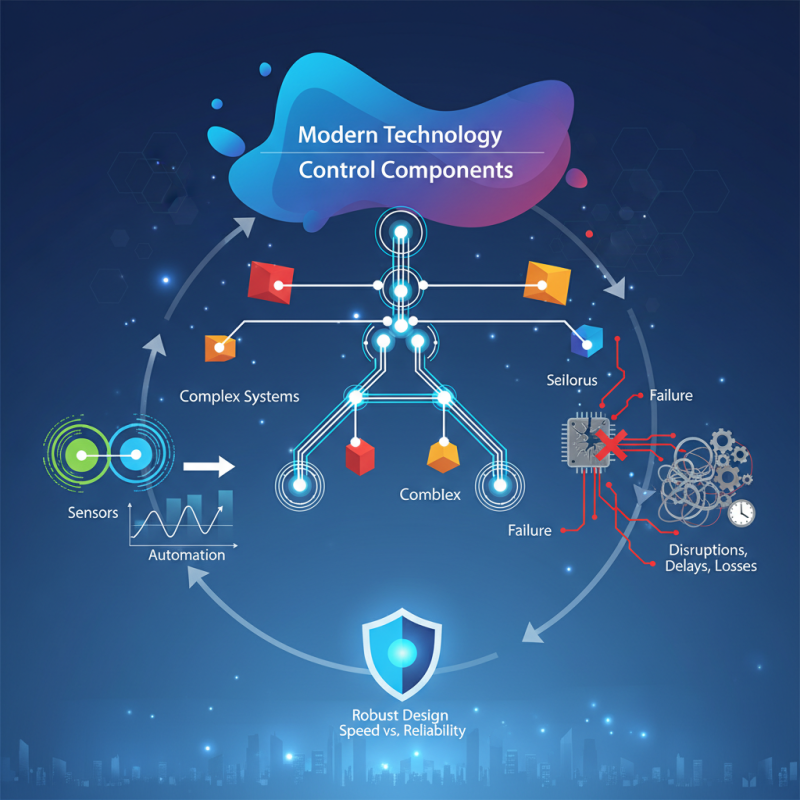
Control Components play a vital role in modern technology. These elements are the backbone of any complex system, providing stability and efficiency. Without effective control components, machines and devices would operate chaotically, leading to potential failures.
For instance, in automation, sensors and actuators serve as critical control components. They allow systems to respond to environmental changes in real time. However, reliance on these components also brings challenges. A failure in one control component can disrupt entire operations, causing delays and losses.
Moreover, the design and integration of these components can often be overlooked. There is a tendency to prioritize speed and performance over reliability. As technology advances, the need for robust control components becomes even more essential. Thoughtful consideration is key to ensuring that systems remain functional and efficient in an ever-changing landscape.
Importance of Control Components in Automation Systems
Control components play a vital role in automation systems. They help manage processes efficiently and improve overall performance. These components include sensors, controllers, and actuators. Each part must work flawlessly to ensure smooth operation.
In many cases, these systems face challenges. For instance, a malfunctioning sensor can lead to incorrect data readings. This may cause improper responses in the automation cycle. Human oversight is still necessary. Operators must regularly check and calibrate equipment to avoid errors. This can be time-consuming but is crucial for reliability.
Another common issue is compatibility. Integrating different control components can be difficult. Sometimes, they just don’t communicate well. Upgrading one component may require revisiting others. This adds complexity to the system. Despite these challenges, the importance of control components cannot be understated. They are the backbone of automation, shaping efficiency in various industries.
Key Technologies: Sensors, Actuators, and Controllers Explained
Modern technology relies heavily on control components such as sensors, actuators, and controllers. According to a report by MarketsandMarkets, the global sensor market is expected to grow from $130 billion in 2020 to $250 billion by 2026. Sensors detect physical phenomena and convert them into signals. These signals provide real-time data for decision-making. However, not all sensors function perfectly. Issues like noise and calibration errors are common. Thus, ongoing refinement is necessary.
Actuators play a vital role as well. They convert signals from controllers into physical actions. A 2022 research revealed that the actuator market alone is projected to reach $80 billion by 2025. But reliability can fluctuate. They may fail under extreme conditions. This poses significant risks in applications ranging from manufacturing to healthcare.
Controllers orchestrate the entire system. They process data from sensors and instruct actuators. An effective controller can vastly improve system efficiency. Yet, they can also introduce complexity. Poorly designed controllers can lead to slow response times. That can be critical in time-sensitive environments. Balancing precision and responsiveness is crucial for optimal performance. The integration and communication between these components remain areas requiring ongoing attention and innovation.
Market Trends: Growth of Smart Home and IoT Control Systems
The smart home and IoT control systems market is booming. Reports show it could grow from $80 billion in 2023 to over $135 billion by 2028. The growth is driven by increasing consumer demand for smart technology. Home automation is becoming a standard. People want convenience and efficiency.
Control components play a crucial role in this expansion. They connect various devices seamlessly. Sensors, hubs, and software facilitate communication. However, not all systems are foolproof. Compatibility issues can arise. Consumers often face frustrations due to a lack of uniformity in products. Important features might not work together.
Despite these hurdles, the potential is immense. People are interested in energy management and security. Studies show that 60% of users prioritize safety features in their smart homes. This trend reflects an essential shift towards integrated control systems. Yet, challenges remain. The industry must address integration issues to make life easier for users. Continuous improvement is necessary. The journey in smart tech is just beginning, but it is already complex.
Impact of Control Components on Energy Efficiency in Industries
Control components play a vital role in modern industries. They directly influence energy efficiency. From automated sensors to advanced actuators, these components drive performance. A well-designed control system can significantly reduce energy waste. However, the implementation is not always perfect. Industries must frequently reassess their processes.
Many factories rely on outdated control technologies. These systems may not adapt to new energy standards. Lack of upgrades can lead to inefficiencies. Some businesses see these components as cost burdens. In reality, they are investments in long-term sustainability. Energy-efficient technologies can lower utility bills. They create a smaller carbon footprint.
Moreover, integrating smart technologies can be challenging. Staff training is necessary for effective operation. Resistance to change is common. Without commitment, potential gains may be lost. Regular evaluations are needed to ensure optimal performance. The impact of control components is significant, yet often underestimated.
Impact of Control Components on Energy Efficiency in Industries
Challenges and Innovations in Control Components for Future Technologies
Control components are crucial for modern technology. They manage operations and ensure efficiency. As we advance, new challenges emerge. Designers must tackle these hurdles while pushing for innovation.
One significant challenge lies in the integration of smart technologies. Many systems today require advanced control methods. Inadequate integration can lead to inefficiencies and failures. For instance, adapting control components for renewable energy sources proves difficult. Smart grids need flexible solutions, but current components often fall short. This gap highlights the need for better designs and materials.
Innovations can address these challenges. Researchers explore new algorithms and sensors that improve feedback. Enhanced automation promises to streamline processes. However, testing these innovations is vital. Researchers often face obstacles in real-world applications. Finding the right balance between complexity and usability remains challenging. Companies need to embrace iterative testing to refine their approaches continuously.
