
2026 Best Flap Turnstile Gates Buying Guide
Choosing the right Flap Turnstile Gates in 2026 requires more than comparing prices and polished product images. A reliable buying decision begins with pedestrian flow, access-control compatibility, safety design, installation conditions, and long-term maintenance.
As security consultant Derek Sanderson explains, “A turnstile is only as strong as the decision behind it.” This practical observation matters in busy offices, airports, campuses, hospitals, and commercial buildings. A narrow lobby may need a compact glass flap gate. A crowded entrance may require wider lanes, faster sensors, or accessible passageways.
Good equipment should open smoothly, close without striking users, and recover quickly after power interruptions. It should also communicate clearly with card readers, biometric devices, visitor systems, and emergency controls. Small details matter. Think of noisy motors, fingerprints on glass panels, wet shoes, luggage wheels, and people walking side by side.
The best Flap Turnstile Gates are not always the most expensive models. They are the ones that fit the site accurately. That sounds obvious, yet many purchasing teams overlook daily traffic patterns and service access.
This 2026 buying guide examines gate types, materials, lane widths, detection technology, safety features, integration options, maintenance needs, and total ownership costs. It also considers a less comfortable question: what happens when the selected model performs well in a showroom but struggles during Monday morning congestion?
No gate solves every problem. Careful planning still matters.
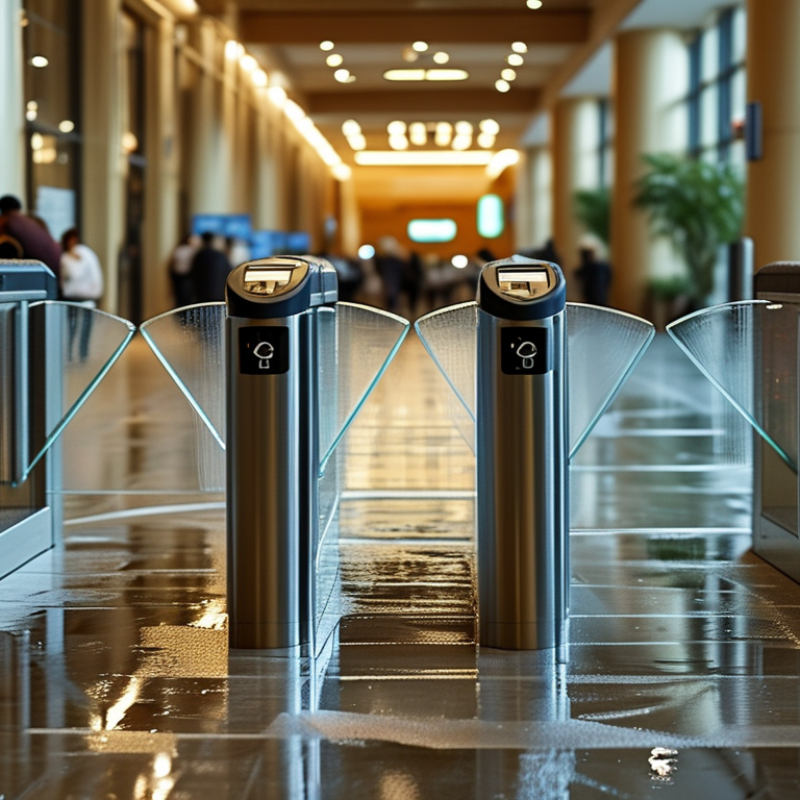
Flap Turnstile Gates: Definition, Purpose, and Operating Principles
2026 Best Flap Turnstile Gates Buying Guide
Flap Turnstile Gates: Definition, Purpose, and Operating Principles
Flap turnstile gates are pedestrian access-control systems with retractable panels. They regulate movement at offices, transit stations, gyms, and secure facilities. Unlike fixed barriers, the flaps create a clear passage after authorization. This design supports orderly entry without making the entrance feel overly restrictive.
The operating process is straightforward. A reader checks a card, QR code, mobile credential, or biometric signal. The controller verifies the permission, then activates a motor. Glass or acrylic flaps retract into the cabinet. Sensors confirm that the user has passed before the panels close. Some models detect tailgating, forced passage, and objects left in the lane. During an emergency, the system can release the passage through an approved safety signal.
Purpose matters more than appearance. A reliable gate should manage traffic, record access events, and reduce unauthorized entry. It should also support accessible lanes and integrate with existing security software. In site assessments, I have found that sensor alignment affects performance more than many buyers expect. Dust, poor lighting, and rushed installation can cause false alarms. No gate is perfect. Maintenance still matters. Buyers should review passage width, motor duty cycle, noise, emergency behavior, and service access before selecting equipment. A polished enclosure cannot compensate for weak controls or unclear operating procedures.
2026 Best Flap Turnstile Gates Buying Guide - Flap Turnstile Gates: Definition, Purpose, and Operating Principles
| Data Dimension | Definition or Typical Specification | Purpose and Operating Principle | Buying Considerations |
|---|---|---|---|
| 1. Product Fundamentals | |||
| Flap Turnstile Gate | A pedestrian access-control gate that uses one or two retractable panels, commonly called flaps, to open or close a passageway. | The flaps remain closed until an authorized access signal is received. After a valid credential is detected, the panels retract into the cabinet to create a passage. | Confirm the gate is intended for indoor use, sheltered outdoor use, or fully exposed outdoor installation. |
| Primary Purpose | To regulate pedestrian movement at controlled entrances and exits. | It combines physical access control with identity verification, passage counting, and unauthorized-entry prevention. | Match the gate type to the required security level, user volume, accessibility needs, and available floor space. |
| Common Applications | Office buildings, transit stations, airports, schools, universities, gyms, stadiums, public facilities, and residential properties. | The gate creates a defined pedestrian lane and can connect to card readers, QR-code scanners, biometric devices, ticketing systems, or visitor-management systems. | Check compatibility with the existing access-control, fire-alarm, building-management, and security-monitoring systems. |
| Passage Direction | Single-direction, bidirectional, or configurable directional operation. | Optical sensors and the controller determine whether entry, exit, or both directions are permitted. | Bidirectional operation is useful where the same lane handles both entering and leaving traffic. |
| 2. Operating Principles | |||
| Authorization Process | Credential presentation followed by access validation. | A reader sends the credential data to an access controller. If authorization is approved, the controller activates the gate motor and unlocks the lane for a preset period. | Verify reader interfaces such as Wiegand, RS-485, Ethernet, USB, relay input, or other required protocols. |
| Flap Movement | Motor-driven panels retract into or extend from the gate housing. | The drive mechanism moves the flaps smoothly while sensors monitor the open, closed, and obstruction positions. | Look for controlled acceleration, low operating noise, anti-pinch protection, and accessible maintenance components. |
| Passage Detection | Infrared or photoelectric sensors monitor the pedestrian position within the lane. | Sensors confirm that the authorized person has passed, prevent premature closing, and help detect tailgating or reverse movement. | More sensor zones generally provide better detection coverage, but correct installation and calibration remain essential. |
| Unauthorized Entry Response | Alarm, warning indicator, gate lock, or event notification when a person attempts to pass without authorization. | The controller compares sensor activity with the access event and can trigger an audible or visual alert. | Choose adjustable alarm behavior to reduce nuisance alerts in busy environments. |
| Power-Failure Behavior | Automatic opening, locked position, or battery-supported operation, depending on configuration. | The emergency mode determines whether the lane remains accessible or secured when normal power is unavailable. | For life-safety routes, the emergency release strategy must comply with local fire and accessibility regulations. |
| 3. Typical Technical Data | |||
| Typical Lane Width | Approximately 550–650 mm for a standard pedestrian lane; wider accessible lanes are commonly about 900–1,000 mm. | The lane width defines the usable passage and determines whether luggage, carts, wheelchairs, or mobility devices can pass. | Measure the site opening and select at least one accessible lane where required by local regulations. |
| Typical Cabinet Width | Approximately 100–200 mm per side for compact designs; larger dimensions may be required for readers, drives, and service access. | The cabinet houses the motor, control board, sensors, wiring, and retractable flap assembly. | Allow additional clearance for installation, cleaning, inspection, and component replacement. |
| Throughput | Typically about 25–35 persons per minute under controlled conditions, depending on credential and user behavior. | Throughput is influenced by the opening cycle, reader response time, lane width, queue design, and the percentage of users requiring assistance. | Use measured peak-hour demand rather than theoretical throughput when calculating the number of lanes. |
| Opening Time | Commonly about 0.5–1.2 seconds after a valid authorization signal, depending on the drive system and configuration. | A short opening cycle supports efficient movement while maintaining controlled access. | Ask for test results under normal load and confirm whether the stated time includes reader processing. |
| Input Voltage | Many systems use a low-voltage internal power supply fed from a site supply such as 100–240 V AC, subject to the equipment design. | The power supply converts incoming electricity for the controller, sensors, indicators, and motor. | Confirm the permitted voltage range, frequency, grounding requirements, surge protection, and local electrical certification. |
| Power Consumption | Often approximately 60–150 W during operation, with actual consumption varying by motor, heater, lighting, and standby design. | Energy is used by the controller, sensors, indicator lights, and motorized flap mechanism. | Request standby and peak operating values when estimating long-term energy use. |
| Operating Temperature | Indoor models commonly support approximately 0°C to 45°C; outdoor-rated models may support a wider range when properly specified. | Temperature limits protect electronic and mechanical components from unreliable operation. | For cold or humid locations, check heater, drainage, condensation control, and enclosure protection options. |
| Ingress Protection | Indoor units may have limited environmental protection, while outdoor installations often require a suitable IP-rated enclosure. | The enclosure rating indicates resistance to dust and water under defined test conditions. | Do not install an indoor model outdoors solely because its cabinet appears sealed; verify the complete system rating. |
| Expected Service Life | Quality systems are commonly specified for several million operating cycles, but the actual life depends on maintenance, traffic, and environment. | Each opening and closing movement contributes to mechanical wear in the motor, gears, sensors, and flap assembly. | Request the rated cycle count, test conditions, replacement-part availability, and warranty terms. |
| 4. Safety, Accessibility, and Security | |||
| Anti-Pinch Protection | Sensor-based or torque-based protection that stops or reverses flap movement when an obstruction is detected. | The system reduces the risk of trapping a person, bag, or mobility device during closing. | Check detection response, closing force, adjustable sensitivity, and compliance with applicable safety requirements. |
| Emergency Release | A fire-alarm input, emergency button, manual release, or automatic unlock function. | During an emergency, the gate can be configured to open or remain safely passable according to the building evacuation plan. | Have the emergency mode reviewed by the responsible fire-safety and facilities professionals. |
| Tailgating Detection | Detection of an additional person attempting to follow an authorized user through one access event. | Sensor data identifies unusual occupancy or movement and can trigger an alarm or event record. | Tailgating detection is affected by lane width, walking speed, crowding, and sensor placement. |
| Accessibility | Accessible configurations may include a wider lane, longer opening time, clear visual indicators, and compatible control devices. | The gate provides a safe route for wheelchair users, people with mobility aids, and users carrying bulky items. | Plan the accessible lane, approach space, threshold, signage, and emergency access together rather than selecting width alone. |
| Security Level | Flap gates provide controlled pedestrian access and visual deterrence but are not a substitute for a full-height barrier in every high-security application. | The barrier delays unauthorized passage while the access-control system verifies credentials. | For higher-risk sites, evaluate integration with guards, CCTV, anti-climb measures, mantrap layouts, and visitor procedures. |
| 5. Selection Checklist | |||
| Traffic Assessment | Record average flow, peak flow, queue length, entry-to-exit ratio, and credential presentation time. | Traffic data determines the required number of lanes and helps prevent congestion. | Consider special events, shift changes, school arrival periods, and cleaning or maintenance closures. |
| Integration Requirements | Access cards, QR codes, tickets, biometrics, facial recognition, visitor systems, alarms, and building-management interfaces. | Integrated systems allow authorization decisions, alarms, passage records, and emergency commands to be managed centrally. | Obtain interface documentation and confirm testing responsibility before purchase. |
| Installation Conditions | Assess floor flatness, anchoring surface, power route, network connection, drainage, lighting, and surrounding clearance. | Stable installation and correct sensor alignment are necessary for reliable flap movement and detection. | Request a site survey when the floor, traffic pattern, or environmental conditions are uncertain. |
| Maintenance Requirements | Routine cleaning, sensor inspection, fastener checks, software or controller testing, and replacement of worn components. | Preventive maintenance reduces downtime and helps preserve detection accuracy and opening performance. | Compare service intervals, technician access, spare-part lead times, and local support capability. |
| Recommended Documentation | Technical datasheet, installation manual, wiring diagram, safety instructions, test reports, warranty terms, and maintenance schedule. | Documentation supports correct installation, commissioning, troubleshooting, and compliance checks. | Do not finalize procurement until the documents cover the selected configuration and site conditions. |